Safer Greenbelt
Unbiased electrical consultation.
Do Greenbelters have unsafe wiring?
Too often, yes.
HAZARDS
Including . . .
- ∇ Stab-lok style circuit breakers.
-
A poor design; too many failed UL's tests—so the manufacturer hoodwinked
UL's inspector. They can be found from Cipriano Road to the Roosevelt Center and beyond.
Not sure what Stab-lok panels look like? The first image offers one small example.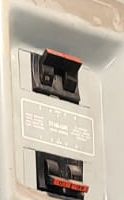
Stab-lok - ∇ Blocked access.
- Can you kill power now?
If someone has to get at your electrical panel fast, will anything get in their way? Too often, the answer is yes.
If someone has to work inside your panel, will they have clear space to work? There's at least one circuit breaker panel in Greenbelt with a water heater added right in front of it, so the back of anyone working in the panel would brush that grounded surface. This is not a trivial danger.
The second image, showing a particularly absurd example of blocked access, was found in a customer's home: someone built a pantry around the electrical panel.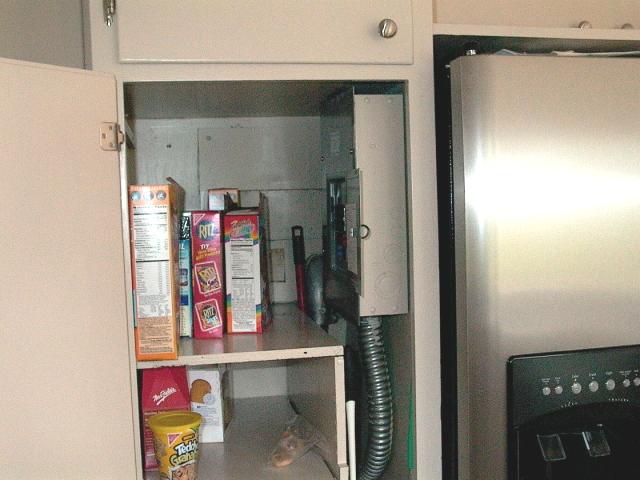
Carpenter-blocked circuit breaker panel
Here's a more common version of this hazard.
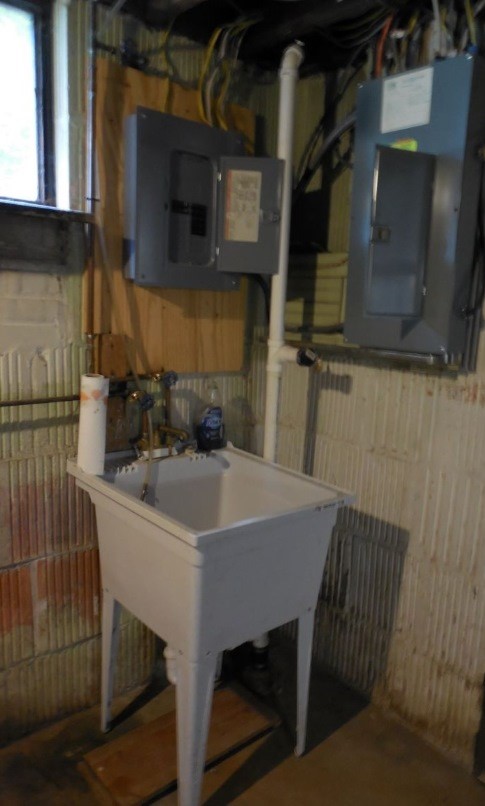
Lean over or stand in a tub to work on wiring? No!
- ∇ Which circuit? Lousy Labeling.
-
In an emergency, you have to get at your electrical panel fast,
to kill power to a sparking circuit. Is it perfectly clear which fuse you'd
pull or which breaker you'd flip, or would you be guessing and hoping?
The owners of this business meant to improve this "we tried" example of inadequate labeling.
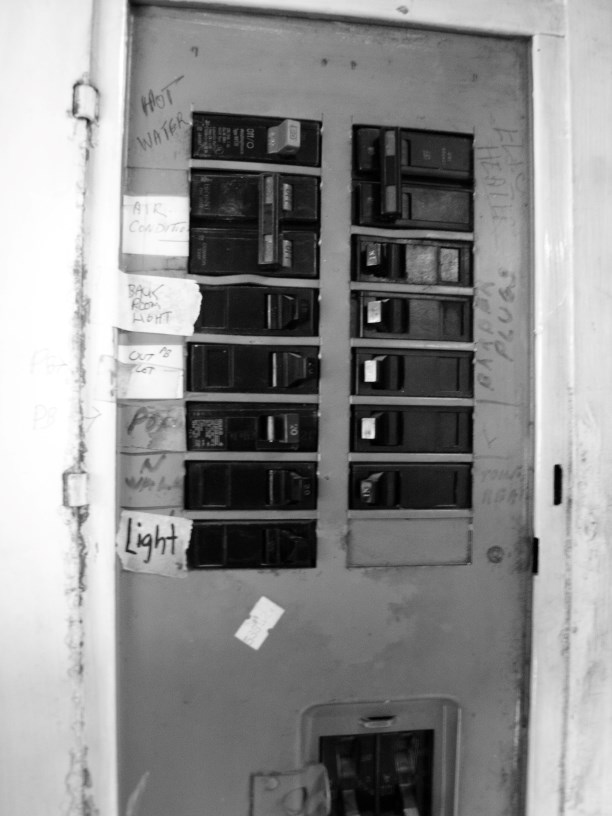
Buildings burn while owners guess at which breaker to switch off.
- ∇ Spiffy New Lights—and Illegal. Modern fixtures attached to pre-1970s wiring.
-
Replacing older-style lights can do a lot to make a house look more up-to-date. There's a problem:
Light fixtures are tested to make sure they won't overheat the wires feeding them. The wires are tested, and marked, to indicate how much heat they can take. The temperature ratings of modern cables—the ones these modern fixtures tend to be designed for—are much higher than those of most Greenbelt homes. This misapplication means the older wiring wears out fast, increasing the risk of fire.
Here's the temperature warning inside one modern fixture. Once the fixture's installed, this is hidden.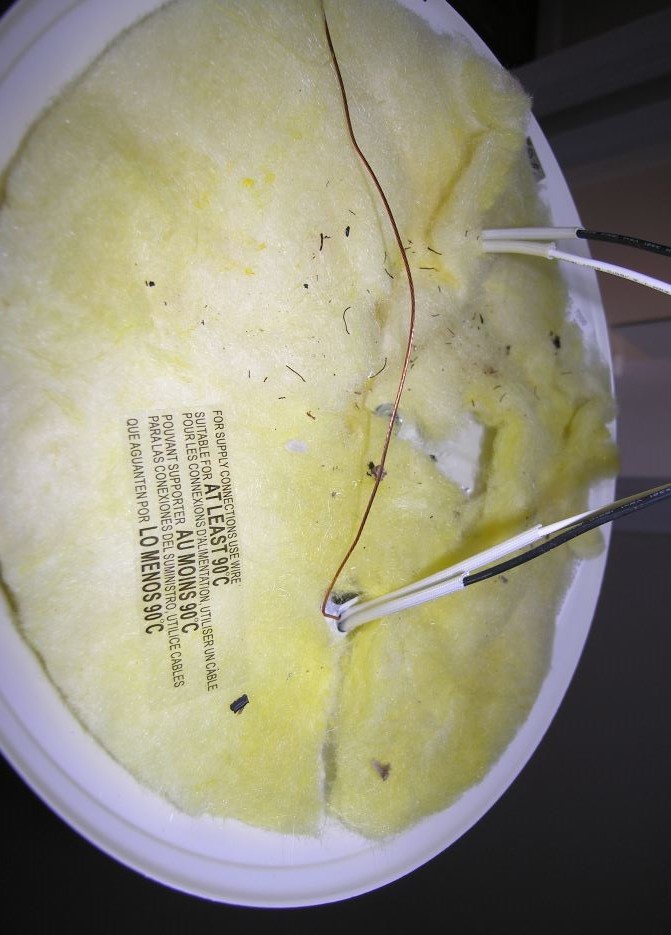
Hidden specification: gets too hot for maybe 1/3 of Greenbelt's wiring.
-
∇ Overfusing: will the circuit open
before something burns?
Overfusing means a fuse or circuit breaker won't protect the size of wire
it feeds. If you run a heavy enough load, the wires in your walls and
ceilings can get dangerously hot.
Here's what happened when one circuit breaker did not trip when it needed to. -
 Insulation scorched and melted when a breaker didn't trip in time.
What do you suppose happened to the house this circuit served?
The odds are that you can't identify a fuse or circuit breaker whose rating is too high, with one exception:
If lights or ordinary receptacles in your home are protected by a 30 amp fuse, this spells danger!
Unfortunately, it takes a professional to recognize most other overfusing situations.
The wrong fuse, hence dangerous, almost anywhere in a home. - ∇ Inadequate wiring.
-
Everybody sees extension cords, or power strips, providing
power where it's needed. UL tests these for
temporary, monitored use, not permanent—or they'd face
tougher tests.
Here's a shiny, white, risky response to inadequate wiring.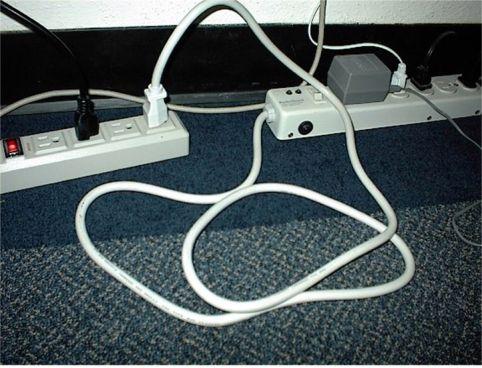
Misused cords. What's worst that can happen? Fire.
These common substitutes are not the only demonstrations of wiring that falls short, and they're certainly not the most serious. A consultation offers a deeper look. -
 outdoors.JPG)
Tidy-looking, ignorant, illegal: risky.
∇ Wrong cable for the location! -
Handypersons run romex outdoors, and it works, and it's cheap. But it's not safe (or legal)—NOT even if it's run inside pipe.
Indoor-rated electrical cable exposed to moisture or unfiltered daylight deteriorates--even if it's installed tidily.
The equipment this cable feeds works! Especially given how tidy it looks, strapped in place, no way is anyone but a qualified electrician or inspector, someone who is there precisely to check for potential trouble spots, going to:- Bother to examine it;
- Read its markings;
- Recognize it's the wrong cable;
- Note the other risky illegalities shown in this picture; and
- Finally, and most important, recognize that the installer's other work may be flawed as well, and check it.
-

Fuzzy image? Rusty pipe that doesn't belong outside; ditto romex.
Misapplied pipe. Raceways, the more-general term for pipe and tubing, are ignorantly misapplied as well. Here's an example of both found in Greenbelt. -
Someone ran romex, standard
nonmetallic-sheathed cable, out through a brick wall and then headed up
the outside of the wall in WiremoldTM. Romex is suitable only for
use in dry locations not exposed to the sun; WiremoldTM is a type
of raceway designed and listed only for indoor use. WiremoldTM has
a distinctive profile; any competent electrician or home inspector knows it
doesn't belong outdoors.
Someone who was not sufficiently knowledgable, and therefore not competent, installed it, saw it worked, and figured, "if it works, it must be safe." If only that were true. -
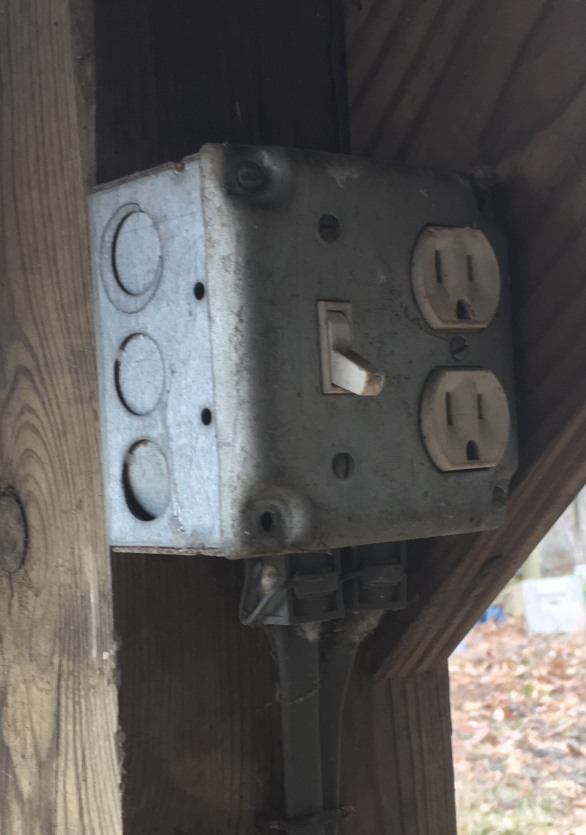
Another handsome installation, but illegal and dangerous.
∇ Outdoor Outlets waiting to shock. -
The GFCI (shock protection) requirement goes back to the 1960s! More and more locations require
this protection—more and more evidence has shown the technology saves lives. Yet there are
homes in Greenbelt that lack it.
The image above is courtesy of a colleague, Bob Sisson (Inspections by Bob). Even if the wiring feeding it enjoyed GFCI protection, an electrician or competent inspector would recognize, as did Bob, that it does not meet current safety requirements. And without GFCI protection? It could lead to electrocution.
The same is true of the old bathroom receptacle below.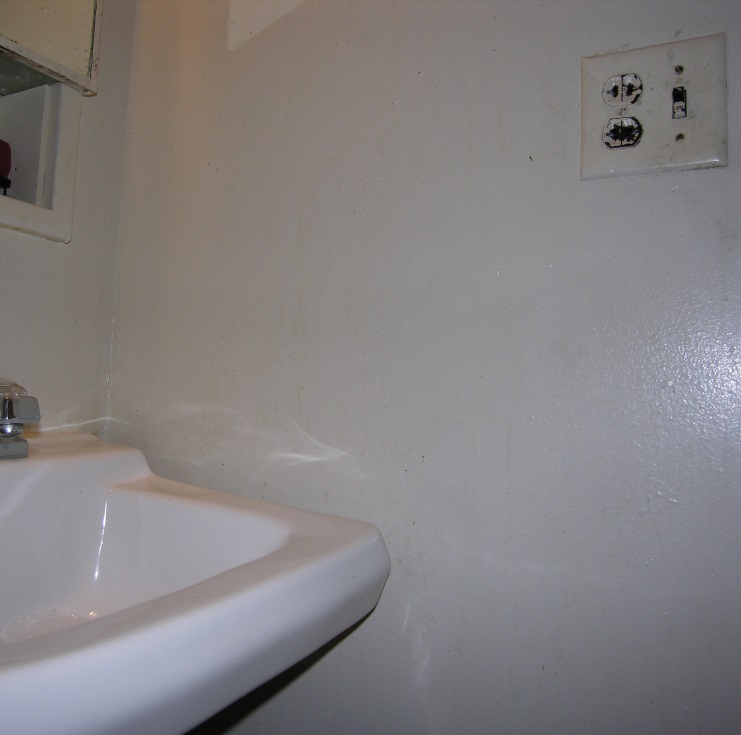
This doesn't meet modern safety standards. (It did once.) -
∇ Fire Code Flaunted -
The installation below shows ignorance of not only the electrical code but
the fire code. Our electrical rules are developed by the National Fire Protection Association.
They're based on knowledge and experience that's unavailable in a
video or a how-to, even one that doesn't have an insulting title.
Backing out a few screws in a Greenbelt wall revealed this Fire Code violation Installers need to keep walls intact enough to slow down the spread of fire.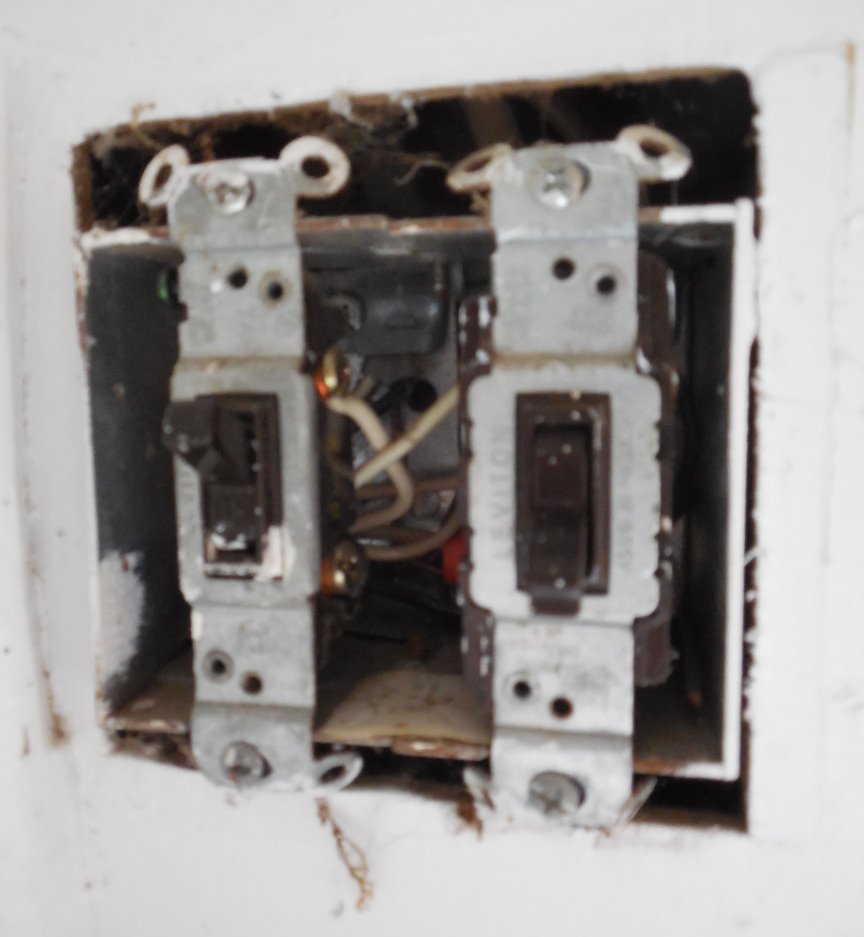
Another hidden fire hazard.
Some of these hazards are discussed in 
Old Electrical
Wiring and 
Your Old Wiring,
published by McGraw-Hill some years back. Both volumes are
available through
certain bookstores, and can be borrowed via Interlibrary Loan: if you have a card and know the system,
sign in at this link for Maryland's Marina interlibrary loan system,
and request Old Electrical Wiring . Alternately, call the
Greenbelt branch at 301-345-5800—or walk in. Their hours are always
posted in the News-Review's Community section.